Mobile apps are a convenient way for users to access an array of information while on the go! We are able to access social media networks, banking information, health documents, and more. But do you ever take the time to consider what information you are allowing those applications to have access to? We’ll download an application, click yes to this and yes to that; allowing access to photos, location, apple/android information, and more. Do you take the time to actually know why those apps request access to all of that? What do they do with that information? Is it absolutely necessary for them to have access to all of what they request? These questions are important because you could be allowing access to deep personal information about yourself and not even realize it.
It is important to be able to increase your awareness on this issue and also let others know that they too should do the same when downloading and interacting on mobile apps. Let’s consider Facebook or Instagram, two popular social networking applications that ask to access your location. Location analytics can play a breech of privacy as well. What if you don’t always want the applications to monitor your every move? You should have the right to do as you please without being monitored. Unfortunately, this isn’t always the case. Location services is only one of many privacy concerns that mobile applications present for a user. Maybe it makes sense to some users why Facebook and Instagram would ask to track locations? Geotagging is a big deal for most users. Maybe you’re at an event, restaurant, lounger or wherever and you really want to let people know, so you tag your location. This obviously cannot be possible if your location services are off. You have the capability to simply tag the business you are with and share it with your friends, colleagues, and family members; awesome! So what’s the problem in this scenario?
Unfortunately with mobile applications, they aren’t always so clear cut as we would like to think. While allowing the applications to track your location could make your experience easier when updating your friends or followers, it could be damaging to you as well. Those exact location services could be shared with third party agencies. Perhaps a brand of some sort is requesting information so that they can plan targeted advertisements in your geographical location. You would be surprised how retail could benefit in collecting location analytics from a mobile app (click here for more)! This is only one example of many. Is this really alright with you? Should an application be selling information to other parties without you fully being aware? It can be pretty startling stuff! I will be analyzing the Data-Privacy Agreement created by Instagram. The main questions I will be looking to solve are:
- What information does the app collect?
- Why do they collect it?
- What do they do with the information you provide? Do they share it?
- Do they retain your data after you delete your account?
Let’s dig deep here and figure out what’s going on!
Analyzing Instagram’s Data Policy
I decided to go right to Instagram’s help center web page. This is a great option that the application offers to its users to be able to read the data policy in detail and it also breaks down popular questions users may have.
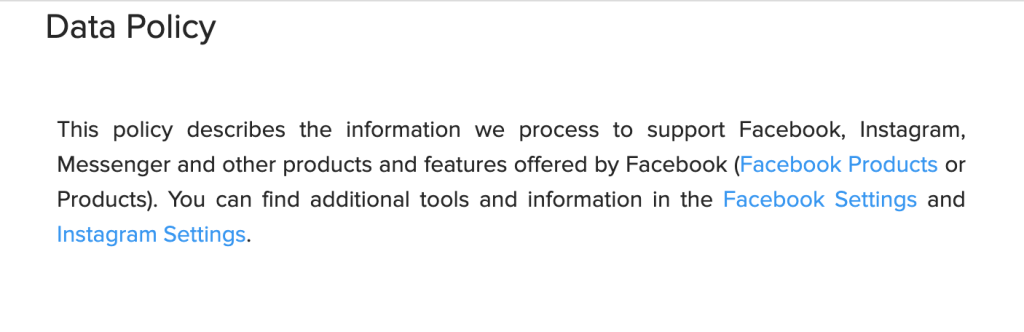
What interest me right away was the statement overview, as shown above. The data that they collect is to support products of Facebook, Instagram, Messenger and other products by Facebook. In other word, they do indeed share your information. What you do on Instagram, won’t always just stay to Instagram. It could in fact be shared with Facebook, the parent company of Instagram, Messenger and other products. Maybe that isn’t a big deal to you? Perhaps, you are already on Facebook and Messenger, so what? Well think about the people who might only be on Instagram or question where else your information could be going. What are those other products? According to the Help Center page on Facebook, you’ll find a startling long list as to where your information could be going too; click here for more.
Information Instagram Collects
Instagram claims that in order to provide support for its Facebook products, the application must take information from their users on the Instagram platform. They also express that what information is taken depends on how the user interacts with the app. Instagram also mentions that the user can change what information the application takes at any time if they click on the Instagram settings. What I found interesting is that when someone downloads the application, a pop up or two will occur for the new user to confirm or deny if the application can access their information. If the user hits yes, they are saying yes to everything Instagram needs to be able to share with their parent company, Facebook, and their other partners. More specifically, that information collected is the following:
- Information you provide about yourself during download and account set up
- All photos you post, likes, comments, messages and tags
- Your location
- Date files are created when and if you use the camera or filters provided by Instagram
- Networks and connection. Who do you interact with the most, what hashtags do you identify with often, pages you interact with more, brands and so on.
- Your usage. When are you on the most? How long are you on for? Do you scroll through your homepage or do you only look at peoples stories? Do you message more on it? Are you looking for new profiles, brands or hashtags? These are only some of the topics Instagram likes to track when it comes to usage data.
- Transaction data. Are you you buying something that was linked to someones profile? Story? Post? Perhaps you are using a sticker or an other product created by Instagram to purchase someones product.
- Information from other parties. Instagram collects information on you from other products owned and operated by Facebook and sometimes even third party companies they’ve worked deals out. Purchase patterns, types of posts you like and how else you may interact on another platform and plenty more.
I don’t know about you, but I was pretty startled to learn about some of that! Instagram explains this to be a necessary part of the experience for their users. They also state in this section of how the system will automatically analyze the new data being shared on the app. Meaning, the second you like, comment, post, message or do anything using the application, Instagram is tracking that and recording it to be analyzed later.
Why Instagram Collects This Data
As stated above, Instagram continues the narrative of collecting this information to be absolutely necessary for Facebook and their partners. The spread of information is meant to enhance the users experience not only on the application itself but also any other applications owned by Facebook and third party partners. If the user is located on those other products, they will be able to have a better experience with tailored information based off of their interactive patterns on the application and others.
What Instagram Does With This Data
Instagram takes this data and analyzes it to help contribute to the users experience, share it with Facebook and its products. They also do share this information with third-parties and vendors who have an agreement with the parent company, Facebook. Third-Parties and vendors can include name brands, schools, private companies and plenty more. It can also depend on what specific data you are talking about.
- Location-date: Current location, where you live, the businesses and people you are near, and the places you like to go. They state this is all to help personalize your experience while on the app; and It will help tailor specific ads in your area.
- Product research and development: They use the information collected form you to help improve and develop new products and features, especially with the help of application surveys the user is prompted to take while on Instagram.
- Facial Recognition: If the user has this option turned on, they use this to recognize the users face in videos and photos.
- Ads and sponsored content: Any and all actions you do on the app is monitored and then shared with third parties so that ads and sponsored content can be placed on your homepage. Instagram describes this to also be a way to increase your experience on the application.
What Happens After You Delete Your Account?
While Instagram gives the user the option to completely erase profile information, clear followers, delete all images and more, it actually still will hold your information internally. While other people or companies won’t be able to find your instagram page, Instagram will still be keeping everything you did for some time. Per the privacy agreement, they will keep data until it is no longe necessary to provide to Facebook and its partners. They also allow people who delete their accounts to have the option of restoring everything if they choose. Thus also indicating that the application, does in fact hold onto your information once you delete it for some time. Be sure to always look into applications privacy and data policies, that way you’ll really know what you’re saying yes too!
Thanks for reading!
-Austin
 The Media Relations Nomad